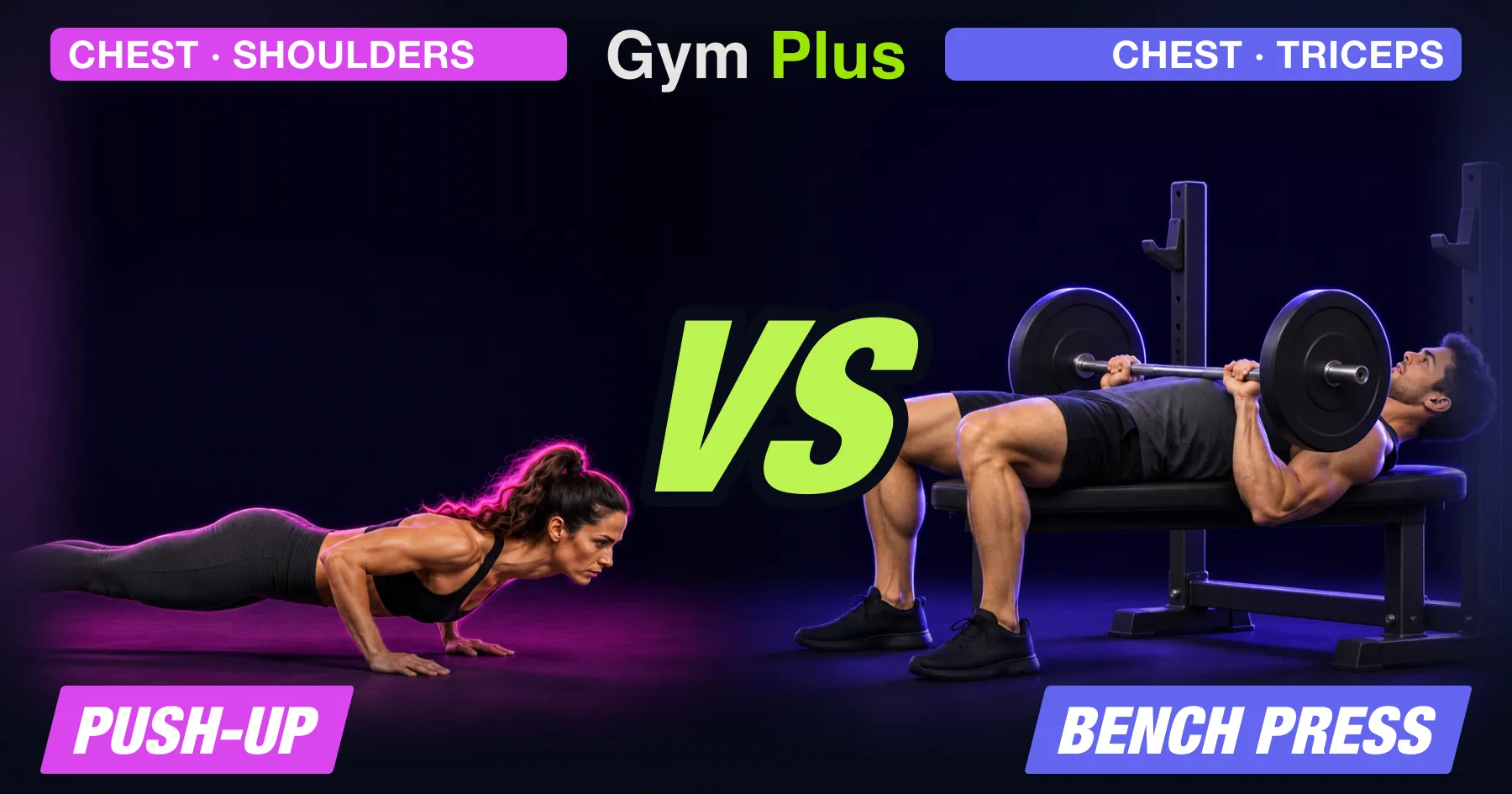
Push-Up vs Bench Press
Short answer
Do both, and alternate them. The bench press is the easiest way to load your chest heavy and track the weight. The push-up trains the same muscles with no equipment, and when you make it hard enough, it builds the chest and pressing strength too.
Push-Up
Lean on the push-up when you train at home or on the road, when you have no spotter, or when you want pressing that also makes your core hold a plank.
How to do itBench Press
Lean on the bench press when you want to lift heavy for low reps, see your progress as a number on the bar, or when push-ups have become too easy to load with what you have.
How to do itHow they differ
| What differs | Push-Up | Bench Press |
|---|---|---|
| Equipment | Push-Up: None to start. Add a vest, band or plates later | Bench Press: Barbell, bench, and a rack with safety pins or a spotter |
| What moves | Push-Up: Your body moves, your hands stay on the floor | Bench Press: The bar moves, your body stays on the bench |
| Load | Push-Up: Part of your body weight, changed by how high your hands and feet are | Bench Press: Whatever you put on the bar, in small steps |
| Shoulder blades | Push-Up: Free to move around your rib cage | Bench Press: Pinned back against the bench |
| Main muscles | Push-Up: Chest, front delts and triceps, with your core holding a plank | Bench Press: Chest, front delts and triceps |
| Making it harder | Push-Up: Slower reps, a deficit, raised feet, then a vest or band | Bench Press: Add a small plate to each side |
A week that uses both
- Upper day 1 · Bench press: 3 sets of 5 to 8. End each set with one or two good reps left.
- Upper day 2 · Push-up: 3 sets of 8 to 15. If you can do more than 15 clean reps, use a harder version so each set ends near your limit.
- Home or travel week · Push-ups on both days, 3 sets each. Make day 1 hard enough that you only get 6 to 10 reps, with a vest, a band or raised feet, and do day 2 at body weight.
The weights don't carry over
There's no weight to copy between these two. A push-up loads only part of your body weight, and that share changes with how high your hands and feet are, so a set of 20 push-ups doesn't tell you what to bench. When you start benching, or come back to it after weeks of push-ups, work up from light sets and find your weight by feel. A weight vest adds to your body weight on the push-up, and it doesn't translate to bench weight either.
If something hurts
Effort in your chest, triceps and front shoulders is normal. If a push-up pinches the front of your shoulder, bring your hands a little closer, angle your elbows back toward your sides and shorten the range. If your wrists ache, push-up handles or dumbbells keep them straight. Stop and get help if pain is sharp, lasting or getting worse.
What the research says
18 men aged 19 to 22 trained twice a week for 8 weeks, either benching at 40% of their one-rep max or doing push-ups adjusted (for example, from the knees) to the same load. Both groups gained bench press strength and chest and triceps thickness, and the authors concluded push-ups at that load were comparably effective.
Source: Kikuchi & Nakazato, 2017, Journal of Exercise Science & Fitness
Workouts with Push-Up or Bench Press
- Full BodyDay 1 - Full BodyBeginner Full Body Routine60 min4 exercisesStrengthBeginner
- Full BodyDay 3 - Full BodyBeginner Full Body Routine60 min4 exercisesStrengthBeginner
- SplitUpper Body Power-UpBeginner Upper/Lower Split60 min6 exercisesStrengthBeginner
- Full BodyBodyweight BlastBodyweight Basics for Beginners60 min4 exercisesStrengthBeginner
Show all (11)
- SplitUpper Body Power-UpBeginner Upper/Lower Split60 min6 exercisesStrengthBeginner
- Full BodyBodyweight BlastBodyweight Basics for Beginners60 min4 exercisesStrengthBeginner
- Full BodyBodyweight BlastBodyweight Basics for Beginners60 min4 exercisesStrengthBeginner
- Full BodyUpper Body BasicsFull Body Beginner60 min4 exercisesStrengthBeginner
- Full BodyDay 3 - Full BodyFull Body Plan for Women45 min5 exercisesStrengthBeginner
- SplitDay 4 - Upper Body & GlutesGlutes and Legs Plan for Women45 min5 exercisesHypertrophyIntermediate
- SplitDay 3 - Upper Body PowerStrength and Conditioning Intermediate60 min4 exercisesStrengthIntermediate
- SplitDay 1 - Chest & TricepsBodybuilding Split Advanced60 min5 exercisesHypertrophyAdvanced
- SplitChest & Back PowerExtensive Routine60 min9 exercisesStrengthAdvanced
Questions
Common questions about Push-Up and Bench Press.
Can push-ups build as much muscle as the bench press?
They can when the load is matched. In an 8-week study, men doing push-ups set to the same load as a light bench press (40% of their max) gained chest thickness and bench strength comparably to men who benched (Kikuchi & Nakazato, 2017). Another study found similar strength gains from band-resisted push-ups and bench presses, both heavy enough for only 6 reps, in experienced lifters (Calatayud et al., 2015). The catch is keeping push-ups hard as you get stronger.
How do I make push-ups harder?
Once you can do about 15 to 20 clean reps, move one step down this list. Slow the lowering to 3 seconds and pause at the bottom. Put your hands on push-up handles or plates so your chest can sink lower than your hands, which is called a deficit. Raise your feet on a box or bench, which puts more load on your hands (Ebben et al., 2011). Add a weight vest, a band looped across your back, or a plate a partner sets on your upper back. Then try harder versions like the archer push-up.
Are push-ups easier on the shoulders than the bench press?
For some people. In a push-up your shoulder blades can move freely, while on the bench they stay pinned to the pad, and some lifters with touchy shoulders find push-ups more comfortable. Muscle effort in the chest and triceps is normal, but a sharp or pinching pain at the front of the shoulder is not. Try bringing your hands closer, angling your elbows back toward your sides and shortening the range first. If the pain is sharp, lasting or getting worse, stop and get it checked by a doctor or physical therapist.
Should beginners do push-ups or the bench press?
Both fit in a beginner's week. If you can't do 8 good push-ups from the floor, put your hands on a bench or box and lower the height over the weeks. Knee push-ups work too. For the bench, start with an empty bar or light dumbbells, and use a rack with safety pins or a spotter.
More comparisons
- Bench Press vs Chest Press
- Chest Fly vs Chest Press
- Deadlift vs Romanian Deadlift
- Good Morning vs Deadlift