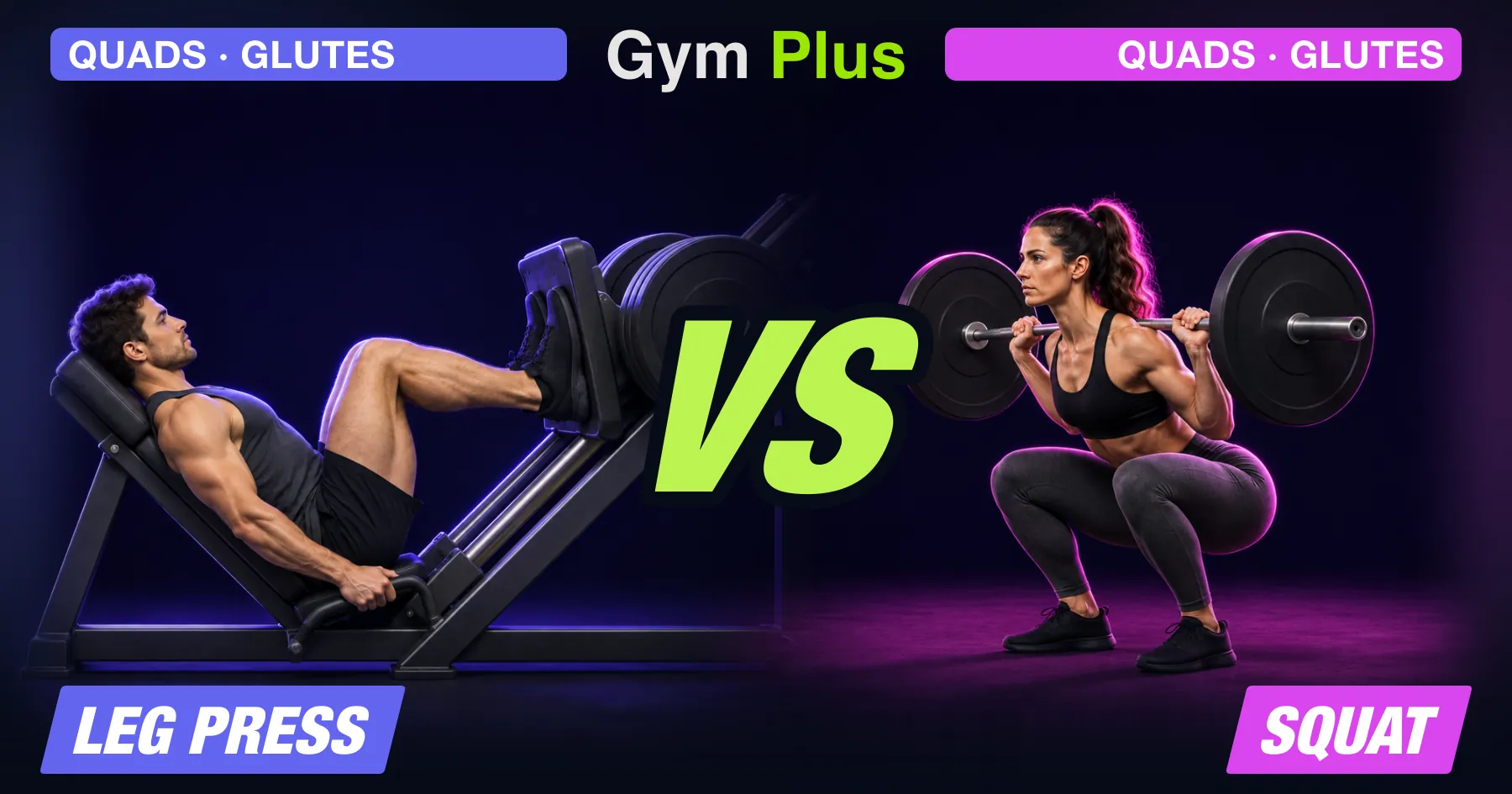
Leg Press vs Squat
Short answer
Do both, and alternate them. The squat builds leg strength you use on your feet, with your back and core holding the bar and keeping you balanced. The leg press lets you push your quads and glutes hard with your back supported and nothing to balance. If you can't squat, the leg press can carry your leg training, but it carries over less to the squat itself.
Leg Press
Lean on the leg press when your lower back or balance limits your squat, when you want hard sets without a spotter, or when you're adding leg volume after squats.
How to do itSquat
Lean on the squat when you want strength that carries over to lifting and moving on your feet, or when getting better at the squat itself is one of your goals.
How to do itHow they differ
| What differs | Leg Press | Squat |
|---|---|---|
| Where the weight sits | Leg Press: On a sled you push with your feet | Squat: On your upper back |
| Back and core | Leg Press: The seat supports your back, so your core does little | Squat: Work hard the whole set to hold your torso upright |
| Balance | Leg Press: None needed; the machine sets the path | Squat: You balance the bar every rep |
| Main muscles | Leg Press: Quads and glutes, with some inner thigh and hamstrings | Squat: Quads and glutes, with your back and core holding the bar |
| Weight used | Leg Press: Much more than you can squat | Squat: Less, because your back and balance set the limit |
| Learning curve | Leg Press: Quick, often a single session | Squat: Takes weeks of practice to own your depth |
A week that uses both
- Lower day 1 · Squat: 3 sets of 5 to 8. End each set with one or two good reps left.
- Lower day 2 · Leg press: 3 sets of 10 to 15. Lower until your knees are well bent but your lower back stays on the pad.
- Next week · Same plan. Add weight to each lift on its own schedule. A jump on one doesn't mean a jump on the other.
The weights don't carry over
Don't swap the numbers between the two. On the leg press the seat holds your back and the sled sets the path, so most people move much more than they can squat. Take your leg press weight to the squat rack and you'll be far too heavy. Log each lift on its own, and expect sleds to differ from gym to gym.
If something hurts
Effort in your thighs and glutes is normal on both. On the leg press, stop lowering before your lower back peels off the pad, and don't snap your knees straight at the top. On the squat, go only as deep as you can keep your back flat. Stop and get help if pain is sharp, lasting or getting worse.
What the research says
Over 10 weeks, people trained their legs with squats only, leg presses only, or both. Squat-only training carried over more to max squat strength than leg press-only training. Effect sizes leaned toward the squat and combined groups for jumping and toward the leg press and combined groups for balance, but those differences were not statistically significant.
Source: Rossi et al., 2018, The Journal of Sports Medicine and Physical Fitness
Workouts with Leg Press or Squat
- Full BodyDay 1 - Full BodyBeginner Full Body Routine60 min4 exercisesStrengthBeginner
- Full BodyDay 2 - Full Body StrengthBeginner Full Body Routine60 min4 exercisesStrengthBeginner
- SplitLower Body Strength BuilderBeginner Upper/Lower Split60 min4 exercisesStrengthBeginner
- Full BodyBodyweight BlastBodyweight Basics for Beginners60 min4 exercisesStrengthBeginner
Show all (12)
- SplitLower Body Strength BuilderBeginner Upper/Lower Split60 min4 exercisesStrengthBeginner
- Full BodyBodyweight BlastBodyweight Basics for Beginners60 min4 exercisesStrengthBeginner
- Full BodyDay 2 - Lower Body StrengthFull Body Beginner60 min4 exercisesStrengthBeginner
- Full BodyDay 1 - Full BodyFull Body Plan for Women45 min5 exercisesStrengthBeginner
- Full BodyDay 3 - Full BodyFull Body Plan for Women45 min5 exercisesStrengthBeginner
- SplitDay 3 - Glutes & QuadsGlutes and Legs Plan for Women50 min5 exercisesHypertrophyIntermediate
- SplitDay 3 - Legs & CoreHypertrophy Focus Intermediate60 min4 exercisesStrengthIntermediate
- SplitDay 4 - Lower Body & CoreUpper/Lower Split Intermediate60 min4 exercisesStrengthIntermediate
- SplitDay 3 - Legs & ShouldersBodybuilding Split Advanced60 min5 exercisesHypertrophyAdvanced
- SplitLeg Day: Power and StrengthExtensive Routine60 min9 exercisesStrengthAdvanced
Questions
Common questions about Leg Press and Squat.
Can the leg press replace squats?
For most gym-goers, it can be your main leg lift: it trains the same main movers, the quads and glutes, and you can push it hard without balancing a bar. It doesn't replace squat strength. In a 10-week study, squat training carried over more to the max squat than leg press training did (Rossi et al., 2018). In another, 8 weeks of squats raised jump height, while the leg press group's change wasn't significant (Wirth et al., 2016). If you can't squat for now, press. If squatting well matters to you, keep at least one squat day.
Is the leg press or the squat better for beginners?
Both work, and you don't have to pick one. The leg press is quick to learn and lets you train hard from your first session. The squat takes a few weeks of practice, so start with a goblet squat or an empty bar and add weight only while your depth and back position stay the same from rep to rep.
Why do I feel squats in my lower back?
Your lower back muscles hold your torso still during a squat, so some effort there is normal. Pain is different. It often comes from your chest dropping and your hips rising first out of the bottom, or from squatting deeper than you can keep your back flat. Lighten the bar, brace before each rep, and squat to the depth you can control. A goblet or front squat keeps your torso more upright. If the pain is sharp, lasting or getting worse, stop and get it checked by a qualified professional.
Can I do squats and leg presses in the same workout?
Yes. Squat first while you're fresh, then use the leg press for extra volume, for example 3 sets of 5 to 8 squats followed by 3 sets of 10 to 15 leg presses. Splitting them across two days, as in the sample week, gives each lift your full effort.
More comparisons
- Bench Press vs Chest Press
- Chest Fly vs Chest Press
- Deadlift vs Romanian Deadlift
- Good Morning vs Deadlift